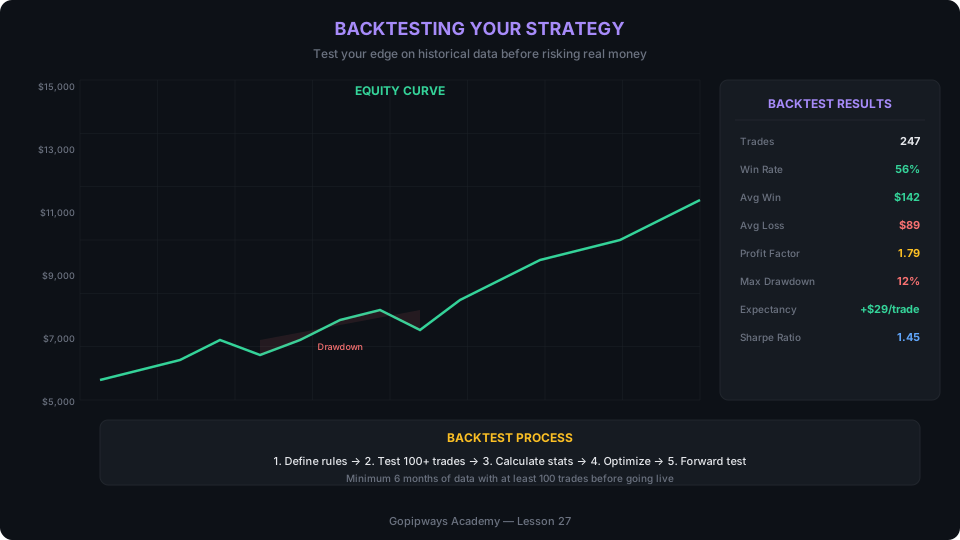
Every year, thousands of retail traders pay for "proven" courses, implement the strategy in live markets, and lose money. They blame the educator, the market, the broker. The one thing they did not do before risking real money: test the strategy against historical price data. Backtesting is the scientific method applied to trading — and skipping it is launching a product without testing whether anyone wants it.
Backtesting is the process of applying a defined trading strategy to historical price data to evaluate its performance before risking real capital. A properly conducted backtest reveals the strategy's edge, expected drawdown, win rate, and profit factor across different market conditions.
The four phases
Phase 1 — Define strategy rules precisely:
Every entry condition, exit condition, stop method, and take profit must be 100% objective. "Buy when it looks bullish" cannot be backtested. "Buy when price closes above the 20 EMA after a pullback to the 50% Fibonacci retracement, stop below the recent swing low" can be.
Phase 2 — Build the dataset:
Minimum 2–3 years of historical data. Include trending, ranging, high-volatility, and news-driven periods. A strategy that only works in strong trends is incomplete.
Phase 3 — Record trades systematically:
For every signal: entry price, stop, target, outcome, market condition, session, news context. Use a spreadsheet.
Phase 4 — Analyse results:
Calculate win rate, profit factor, expectancy, maximum drawdown, maximum consecutive losses, annual return. Compare across pairs, timeframes, and conditions.
Backtest results summary (EUR/USD, 1H, 18 months):
| Metric | Result | Benchmark |
|---|---|---|
| Total trades | 247 | ≥100 required |
| Win rate | 44% | Not the key metric |
| Avg win | 2.3R | |
| Avg loss | 1.0R | |
| Profit factor | 1.81 | Need ≥1.25 |
| Max drawdown | 8.2% | Acceptable ≤15% |
| Expectancy | +0.49R/trade | Positive = edge |
Conclusion: Strategy has edge. Proceed to forward-testing on demo.
NGX parallel: An NGX equity trader backtesting a "buy pullback to 20-week EMA on NGX top-20 stocks" strategy across 5 years on MTNN, DANGCEM, GTCO, ZENITH, and NESTLE found: 68% win rate, profit factor 1.62, max drawdown 11%. The backtest provided conviction to deploy real capital — knowing exactly what to expect in different conditions.
Curve fitting — tweaking strategy parameters until the backtest looks perfect. Testing 50 parameter combinations and showing only the one that worked historically is optimising for the past, not the future. The strategy will likely fail in live trading. Test with fixed parameters determined by logic, not by data mining.
After a positive backtest, paper-trade in real-time for 30–50 trades (forward test) before committing real capital. This catches implementation issues (entries you miss, exits you take early), psychological challenges, and confirms the edge holds in current conditions.
A backtest with 100+ trades, positive expectancy, acceptable maximum drawdown, and profit factor above 1.25 is the minimum evidence required before committing real capital to any trading strategy.