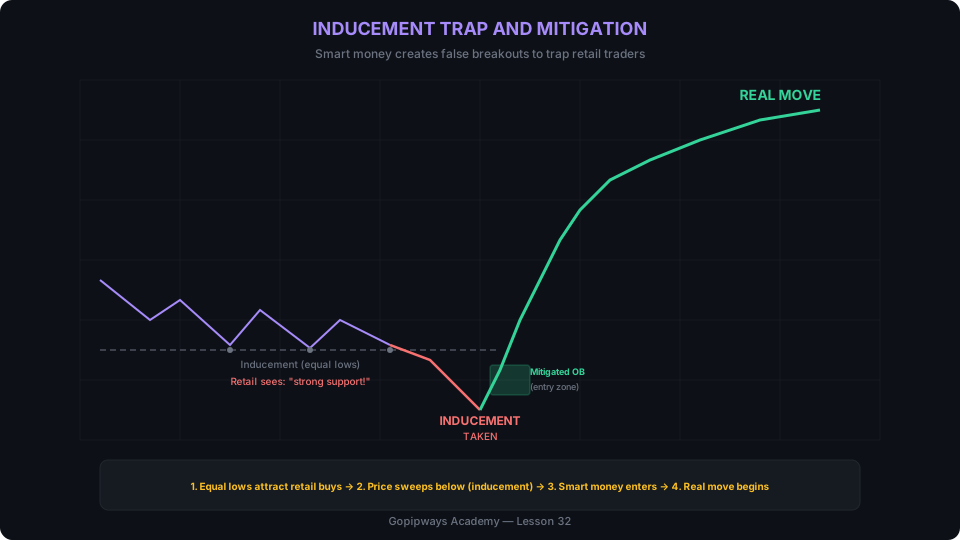
You see a beautiful support level, the textbook setup — price has bounced there three times, there is a bullish engulfing candle, RSI is oversold. You enter long. Price immediately spikes below your stop, takes you out, and then rallies exactly where you expected. You were not unlucky. You were the inducement. Your stop loss was the liquidity that institutional traders needed to fill their buy orders. Understanding inducement is understanding why "perfect" retail setups fail — and how to use that knowledge instead of being used by it.
Inducement is a price move engineered to lure retail traders into positions that will be stopped out — creating liquidity for institutional entry. Mitigation is the process where price returns to a previously unmitigated order block or FVG to fill remaining institutional orders before continuing in the intended direction.
How inducement works
1. Price creates an obvious technical pattern (double bottom, trendline bounce, indicator signal)
2. Retail traders enter based on the pattern, placing stop losses at predictable levels
3. Price sweeps through those stops — triggering them and creating liquidity
4. Institutional traders use that liquidity to fill their actual positions
5. Price reverses in the intended institutional direction
Key insight: The "fake" setup was real — it was just designed to generate stop losses, not profitable entries.
Recognising inducement
Look for these red flags:
- Too-perfect setups: When a support bounce looks textbook, ask who is selling at that level
- Equal highs/lows: Clean double tops/bottoms are liquidity targets, not reliable S&R
- Minor structural breaks: Small CHoCH that seems to confirm a reversal, only to reverse again
- Trendline liquidity: Price breaks below a trendline (triggering sell stops) then immediately reclaims it
Mitigation explained
When institutional traders place large orders, they often cannot fill everything at once. The unfilled portion remains as a mitigation block — a price level the market must return to so institutions can complete their order.
Mitigated vs unmitigated levels:
- Unmitigated OB/FVG: Price has not returned to this level yet → expect a return visit
- Mitigated OB/FVG: Price already returned and reacted → institutional orders filled, level is spent
Trading rule: Only trade order blocks and FVGs that are unmitigated (first visit). Second and third visits have significantly reduced probability because institutional orders have already been filled.
The inducement-to-entry workflow
1. Identify the higher-timeframe bias (bullish or bearish)
2. On the lower timeframe, watch for inducement (retail pattern forming against the HTF bias)
3. Wait for the inducement sweep (stops taken)
4. Enter in the direction of the HTF bias after the sweep, using the unmitigated OB/FVG as your entry
EUR/USD inducement sweep to long entry:
Daily bias: bullish (BOS confirmed, price in discount zone).
1H chart: price forms a "bearish flag" — retail traders short it.
Their buy stops cluster above the flag's high.
Price breaks ABOVE the flag briefly (sweeping buy-side) then drops back.
Retail shorts stopped out. Price drops into an unmitigated 4H bullish OB at 1.0840.
Bullish engulfing inside the OB → Entry: 1.0845
Stop: 1.0815 (below OB) · Target: 1.0940 (next liquidity pool)
Risk: 30 pips · Reward: 95 pips · R:R: 1:3.2
NGX parallel: ZENITH BANK drops below ₦32 support (stop hunting longs) — volume spikes as retail stops trigger. Within 2 days, price recovers to ₦33.50 and continues to ₦36. The drop below ₦32 was inducement — institutional buyers needed the sell liquidity from triggered stops to accumulate at better prices. NGX's thinner liquidity makes these sweeps even more pronounced.
Trading an order block that has already been mitigated (visited once). Each return to an OB fills more of the institutional order. By the second or third visit, there may be no orders left to defend the level. Always check: is this OB's first return visit? If not, reduce your position size or skip it entirely.
The strongest SMC setups combine all three: inducement sweep (liquidity taken) → price drops into an unmitigated OB → that OB sits inside an FVG → all of it in the discount zone of the higher-timeframe swing. When you see this 4-factor setup, it is the institutional equivalent of a full house in poker.
Inducement is the mechanism that makes "perfect" retail setups fail — understanding it lets you trade alongside institutions instead of being their exit liquidity, while mitigation tells you which levels still have unfilled institutional orders worth trading.