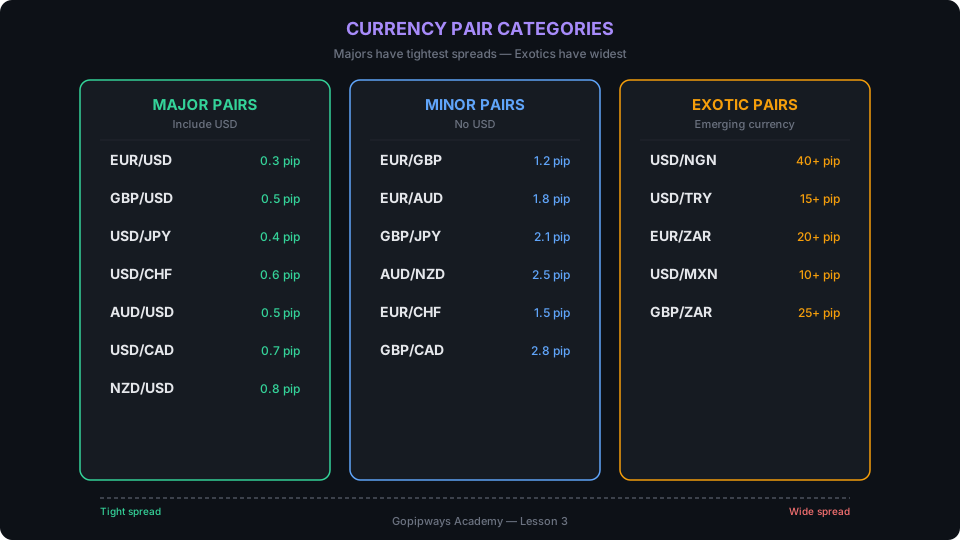
Walk into any Nigerian bureau de change and you'll see rates for USD, GBP, and EUR on the board. Tight rates, fast service — the staff know these currencies inside out. Ask for the Czech koruna rate and you'll get a blank stare. That is exactly the difference between major, minor, and exotic pairs, and it explains everything about which ones you should trade first.
Currency pairs are grouped by liquidity and volume. Major pairs always include USD and have the tightest spreads. Minor pairs pair two major currencies without USD. Exotic pairs include one emerging-market currency and carry much wider spreads and higher volatility.
Major pairs — your home base
| Pair | Nickname | Description |
|---|---|---|
| EUR/USD | Fiber | Euro vs US Dollar |
| GBP/USD | Cable | British Pound vs Dollar |
| USD/JPY | Ninja | Dollar vs Japanese Yen |
| USD/CHF | Swissie | Dollar vs Swiss Franc |
| USD/CAD | Loonie | Dollar vs Canadian Dollar |
| AUD/USD | Aussie | Australian Dollar vs Dollar |
| NZD/USD | Kiwi | New Zealand Dollar vs Dollar |
EUR/USD alone represents roughly 23% of all Forex trades daily. Spreads are paper-thin, behaviour is predictable. This is where beginners belong.
Minor pairs — removing the dollar
EUR/GBP, EUR/AUD, GBP/JPY. Two major currencies without USD. Slightly wider spreads, can move sharply when both economies release data on the same day.
Exotic pairs — high spread, high caution
USD/NGN, USD/ZAR, USD/TRY. Spreads can be 30–100 pips. News events cause gaps and slippage. Not for beginners — but every Nigerian trader should understand USD/NGN structurally.
Spread comparison:
- EUR/USD spread: 0.2 pips → on 0.1 lot, you start $0.20 in the hole
- USD/NGN spread: 40 pips → on 0.1 lot, you start $4.00 in the hole
To break even on EUR/USD, price needs to move 0.2 pips in your favour. On USD/NGN, it needs 40 pips. That spread cost compounds across every trade you take.
NGX parallel: Blue-chip NGX stocks like MTNN, GTCO, and ZENITH are the equivalent of major pairs — high volume, tight bid-ask spreads, predictable price behaviour. Small-cap and mid-cap stocks are the exotics — wide spreads, thin volume, erratic moves. The logic of starting with the most liquid instruments applies identically.
Beginners are drawn to exotic pairs because "USD/TRY moved 300 pips!" sounds exciting — until you realise the spread was 100 pips and volatility hit your stop twice before the move happened. Stick to majors until you are consistently profitable.
USD/JPY is an excellent second pair for beginners. It is heavily influenced by one factor — Bank of Japan policy — making it more predictable than pairs driven by multiple variables. The 2-decimal pip value also forces you to calculate carefully, building a good habit.
Start with EUR/USD, master one pair before adding another, and avoid exotic pairs until your risk management is rock solid — the wide spreads make them unforgiving.