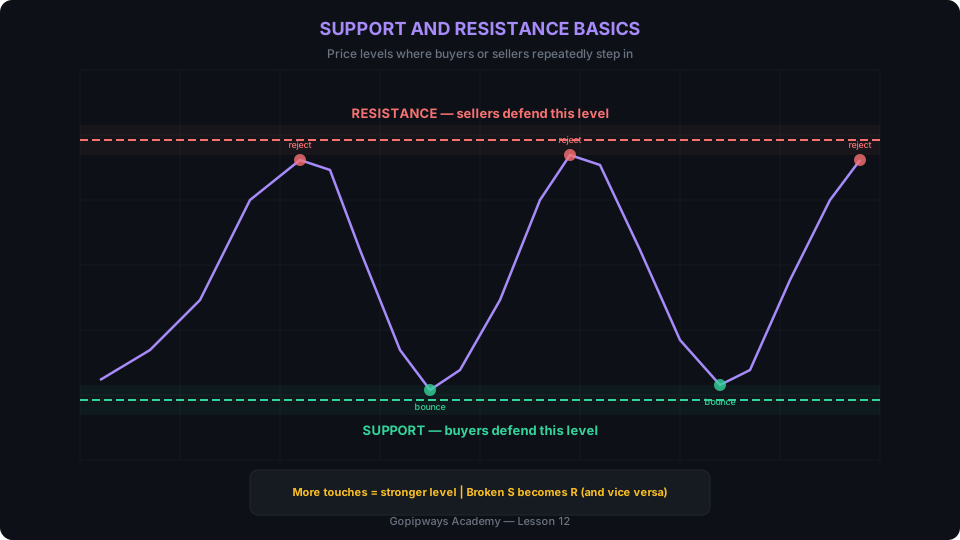
Imagine a Lagos market where rice has traded near ₦50,000 a bag for months. Every time it creeps toward ₦55,000, buyers disappear — too expensive. Every time it dips to ₦45,000, a queue forms — everyone senses a bargain. Those price points where buyers reliably appear and sellers reliably appear are support and resistance. They exist in every market on earth, because human psychology is universal.
Support is a price level where buying interest consistently overcomes selling pressure, causing price to bounce upward. Resistance is where selling interest consistently overcomes buying, causing price to reverse downward. These are the most fundamental and powerful concepts in all of technical analysis.
Why they work
They work because of memory. Traders who bought at a level and watched it fall (trapped buyers) want to exit at breakeven when price returns — creating selling pressure. Traders who missed a move want a second chance — creating buying at pullback levels. These crowd behaviours repeat reliably.
How to identify them
1. Use a higher timeframe (daily or 4-hour) to mark major levels first
2. Look for areas where price has reversed multiple times — two tests = weak, three or more = strong
3. Mark zones, not precise lines — support is not at exactly 1.0850, it is the 1.0840–1.0860 zone
4. Recognise role reversal: broken resistance becomes new support. Broken support becomes new resistance
Role reversal trade:
EUR/USD is resisted at 1.0900 (rejected twice). Price breaks above 1.0900 on heavy volume and closes at 1.0940.
On the next day, price pulls back to 1.0900.
Former resistance = now support.
Entry: 1.0905 · Stop: 1.0860 (below zone) · Target: 1.0980 (next resistance)
Risk: 45 pips · Reward: 75 pips · R:R: 1:1.67
NGX parallel: DANGCEM spent months building resistance at ₦600. When the stock finally broke above ₦600 on an earnings beat and held there for a week, ₦600 became support. Buying on the first pullback to ₦600 — with a stop below ₦590 — was a textbook role-reversal setup on the Nigerian Exchange.
Drawing so many lines that everything looks like support or resistance. A chart with 20 levels is useless — every price is "near" a level. Start with the 3–4 most obvious, cleanest levels where price has reversed convincingly multiple times. Fewer and stronger always beats many and weak.
The more times a level is tested and holds, the stronger it is — but also the more explosive the eventual breakout will be. A support tested 5 times has accumulated stop orders just below it. When it finally breaks, the cascade of those stops creates a fast, powerful move. This is the engine of breakout trading.
Support and resistance are price zones where crowd psychology reliably repeats — master identifying these levels and you will know where the highest-probability entries and exits are before price even arrives.