In 2021, a retail trader turned a $1,000 account into $48,000 in three weeks using 500:1 leverage. Three weeks later, a margin call wiped the entire balance. He had discovered the double-edged sword that has destroyed more trading accounts than any strategy failure ever has. Leverage is the most powerful tool in Forex — and the most dangerous if you do not understand it precisely.
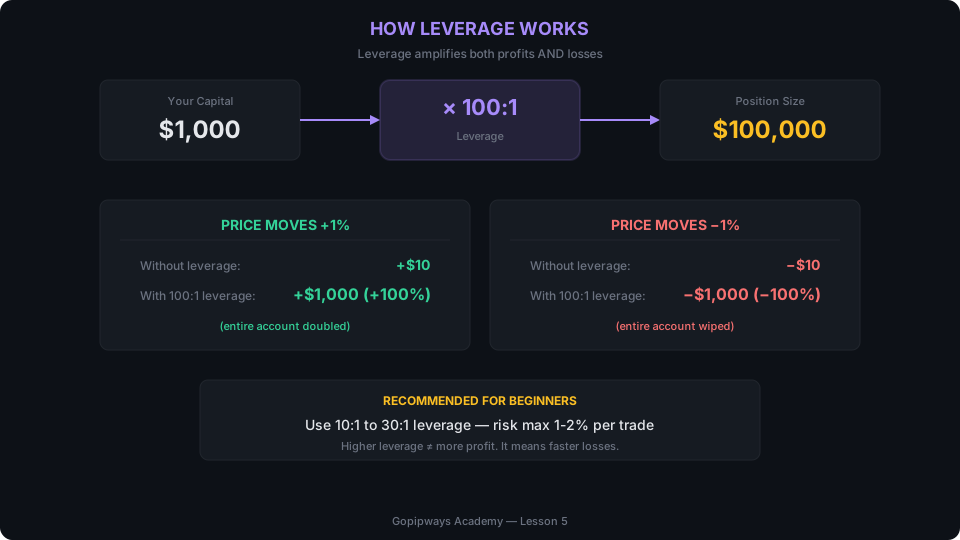
Leverage lets you control a position larger than your account balance. With 100:1 leverage, a $1,000 deposit controls a $100,000 position. Every pip movement in that $100,000 position hits your $1,000 account in full — amplifying both profits and losses by 100x.
How leverage works
With $1,000 and 100:1 leverage:
- Buying power = $1,000 × 100 = $100,000
- You can open 1 standard lot EUR/USD
A 50-pip move = $500 profit → 50% return on your $1,000.
Now the other side: a 100-pip move against you = $1,000 loss — your entire account, without a crash. Just a bad afternoon.
Margin — the deposit behind the position
When you use leverage, your broker holds a portion of your account as margin — a good-faith deposit securing the position.
Margin = (Position size × price) ÷ Leverage
1 lot EUR/USD at 1.0850 with 100:1: ($100,000 × 1.0850) ÷ 100 = $1,085 required margin
If losses erode your free margin below the broker's threshold, you get a margin call — positions auto-close at a loss.
Two traders, same account, same trade, different leverage:
Account: $5,000. EUR/USD entry: 1.0850. Stop: 50 pips. Target: 100 pips.
Trader A (10:1 effective): 0.1 lot → Risk: $50 (1%) → Potential profit: $100
Trader B (100:1 effective): 1.0 lot → Risk: $500 (10%) → Potential profit: $1,000
After 10 consecutive losses (possible even with a 60% win rate):
Trader A is down 10% and recovers. Trader B's account no longer exists.
NGX parallel: The Nigerian Exchange is a cash market with no leverage. But some Nigerian traders access CFDs on NGX stocks through offshore brokers offering 5:1 leverage. The same principle applies — leverage amplifies NGN exposure beyond your deposit. Without strict position sizing, a sharp sell-off in an illiquid mid-cap forces margin liquidation at the worst possible price.
Using the maximum leverage your broker offers because it is available. Brokers offer high leverage as a marketing tool — it generates more spread revenue for them. Your job is to ignore the maximum and use only what fits inside your risk management rules.
Think in terms of effective leverage (position notional ÷ account balance), not your broker's advertised ceiling. Keep effective leverage below 10:1 as a beginner. Once you are consistently profitable for 6 months, you can reconsider. Not before.
Leverage multiplies every outcome — a beginner's goal is to use the minimum effective leverage that still generates meaningful returns while keeping each trade's risk at 1–2% of account equity.