A moving average is the most boring indicator on a chart. It is a slow, lagging line that always arrives late to the party. And yet every professional trader in the world watches it. Why? Because while price is noisy and emotional, the moving average cuts through that noise to reveal the underlying trend with clean, emotionless precision. It does not predict. It confirms. And confirmation is exactly what disciplined traders need.
A moving average calculates the average closing price over a defined number of periods and plots it as a line. The SMA (Simple Moving Average) gives equal weight to all periods. The EMA (Exponential Moving Average) weights recent prices more heavily — making it faster and more responsive to current price action.
The key moving averages
| MA | Periods | Primary use |
|---|---|---|
| 20 EMA | 20 candles | Short-term trend, dynamic S&R |
| 50 EMA | 50 candles | Medium-term trend direction |
| 200 EMA | 200 candles | Long-term bull/bear dividing line |
Golden Cross: 50 EMA crosses above 200 EMA → major bullish signal.
Death Cross: 50 EMA crosses below 200 EMA → major bearish signal.
Three core MA strategies
1. MA as dynamic S&R: In a strong uptrend, price bounces from the 20 EMA. Buy when price touches the 20 EMA and shows a bullish candle. Stop below the EMA.
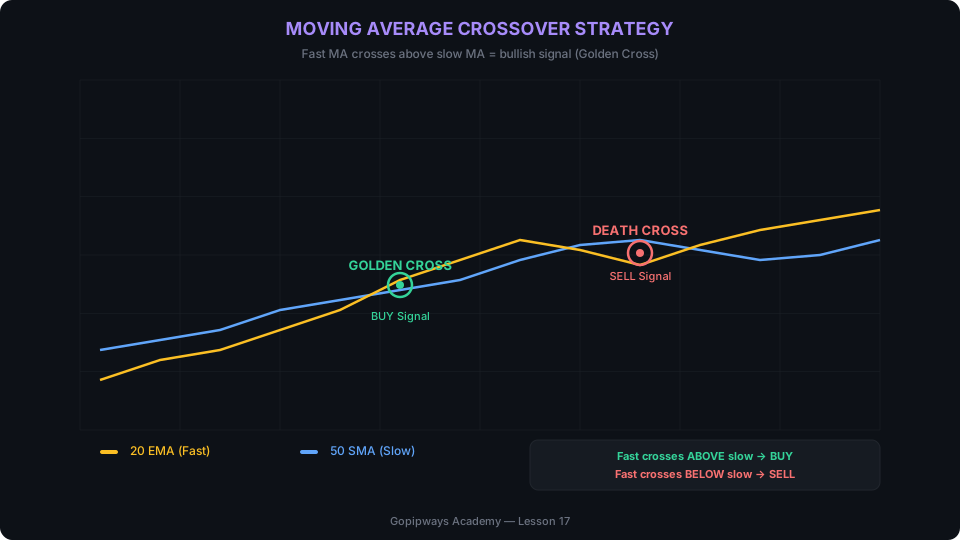
2. MA crossover: When fast MA (20) crosses above slow MA (50), trend has shifted bullish. Enter on the next pullback.
3. 200 EMA bias filter: Price above the 200 EMA → only look for buy setups. Below → only look for sells. This one filter eliminates an enormous number of bad trades.
200 EMA bias + 20 EMA entry:
EUR/USD above the daily 200 EMA → bias is bullish, only buys.
On the 4H chart, price pulls back to touch the 20 EMA at 1.0880.
Bullish engulfing candle forms at the touch.
Entry: 1.0885 · Stop: 1.0855 (below 20 EMA) · Target: 1.0960 (daily resistance)
Risk: 30 pips · Reward: 75 pips · R:R: 1:2.5
NGX parallel: On the MTNN weekly chart, the 20-week EMA has acted as consistent dynamic support throughout the 2022–2024 uptrend. Each pullback to the EMA provided low-risk buy entries for patient investors. The 200-week EMA serves as the ultimate support on NGX blue chips — a break below it on a weekly close is a major warning to exit longs.
Trading every MA crossover without additional confirmation. The 20/50 EMA crossover generates false signals frequently in ranging markets. Always require an additional confirmation — a key S&R level, trend structure, or candle pattern — before acting on a crossover alone.
Moving averages are trend-following tools. They perform beautifully in trending markets and terribly in ranging ones. Before using MA-based strategies, check whether the market is trending (use price structure or ADX). If ranging, switch to range-bound strategies and ignore MA signals entirely.
Use the 200 EMA to set directional bias, the 20 EMA as dynamic support for entries, and avoid MA strategies entirely during sideways ranging conditions.