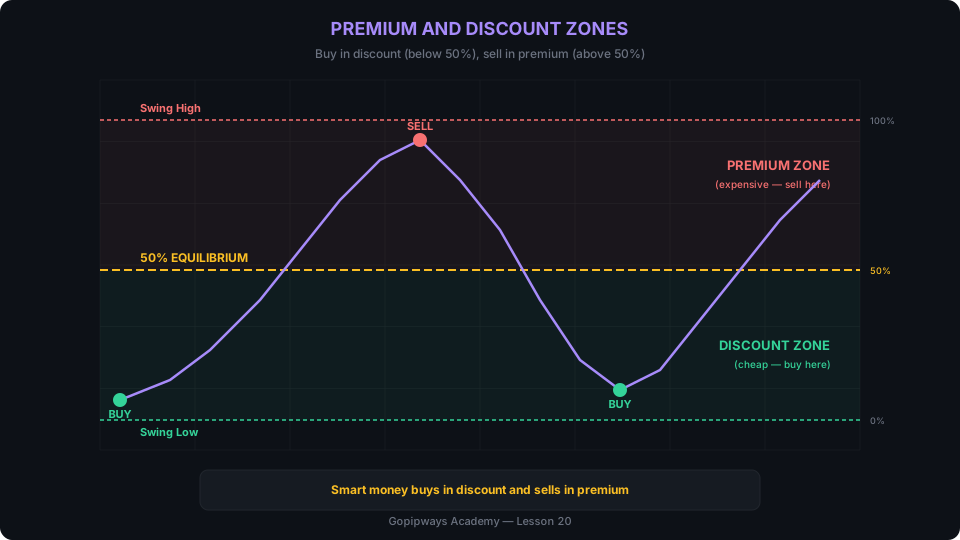
Warren Buffett's most famous rule is "buy low, sell high." Smart Money traders have a mathematical framework for what "low" and "high" actually mean on a chart. They divide every price swing into premium and discount zones using a simple equilibrium line — and they only buy in the discount and only sell in the premium. This single filter eliminates the majority of losing trades that retail traders take.
Premium and Discount Zones divide a price range (from swing low to swing high) into two halves using the 50% equilibrium level. The discount zone is the lower half (below equilibrium) — where smart money buys. The premium zone is the upper half (above equilibrium) — where smart money sells. The equilibrium (50%) level itself acts as a dynamic pivot.
How to draw the zones
1. Identify the most recent significant swing high and swing low on your timeframe
2. Draw a Fibonacci retracement from swing low to swing high
3. The 50% level = equilibrium
4. Below 50% = discount zone (buy zone)
5. Above 50% = premium zone (sell zone)
The logic behind it
Institutional traders accumulate positions at discounted prices (below equilibrium) and distribute them at premium prices (above equilibrium). By aligning your entries with this logic, you trade alongside institutional order flow rather than against it.
In a bullish trend: Wait for pullbacks INTO the discount zone before buying. Never chase price in the premium zone.
In a bearish trend: Wait for rallies INTO the premium zone before selling. Never chase price in the discount zone.
Combining with other SMC tools
Premium/discount zones become powerful when combined with:
- Order Blocks in the discount zone → highest probability buy entries
- Fair Value Gaps in the discount zone → price magnets pulling into your entry zone
- BOS confirmation after price reaches discount → trend continuation confirmed at optimal price
The equilibrium as support/resistance
The 50% level frequently acts as a pivot:
- In strong uptrends, pullbacks often bounce at or near equilibrium
- In weak uptrends, price breaks through equilibrium into discount (deeper pullback)
- If price cannot reclaim equilibrium after breaking below it → trend may be shifting
GBP/USD discount zone entry:
Swing low: 1.2600 · Swing high: 1.2800
Equilibrium (50%): 1.2700
Discount zone: 1.2600 – 1.2700
Premium zone: 1.2700 – 1.2800
Price pulls back to 1.2650 (in discount). Bullish OB at 1.2640.
Bullish engulfing candle forms at OB → Entry: 1.2660
Stop: 1.2620 (below OB) · Target: 1.2780 (premium zone)
Risk: 40 pips · Reward: 120 pips · R:R: 1:3.0
NGX parallel: GTCO traded between ₦28 and ₦42 over 3 months. Equilibrium = ₦35. Smart NGX traders accumulated shares only below ₦35 (discount) and took partial profits above ₦35 (premium). Those who bought at ₦40+ (chasing in premium) consistently saw drawdowns before any further upside.
Buying in the premium zone because "the trend is strong and it keeps going up." This is the most common reason retail traders enter at the worst possible prices. Strong trends pull back — and they pull back to the discount zone where institutions are waiting. Patience to wait for discount entries is what separates profitable SMC traders from retail chasers.
Add the 50% equilibrium level to every trade setup as a filter. If your buy entry is above equilibrium, skip it. If your sell entry is below equilibrium, skip it. This one rule alone can eliminate 40-60% of your losing trades without reducing winners, because most losses come from entries at the wrong end of the range.
Premium and discount zones provide a mathematical framework for buying low and selling high — only enter longs in the discount zone and shorts in the premium zone, and you align every trade with institutional order flow.