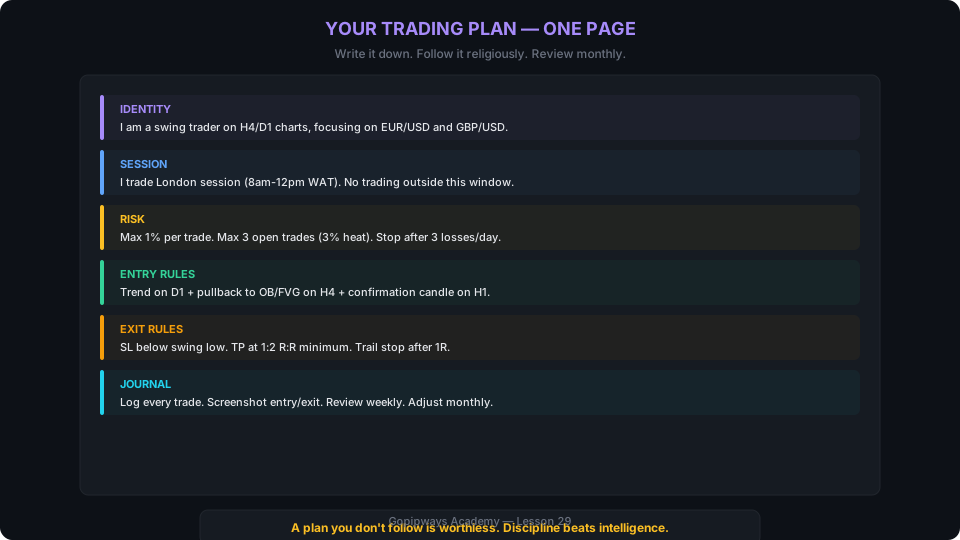
Paul Tudor Jones, who predicted Black Monday 1987 and made a fortune while the market crashed, says the same thing in every interview: "I spend my time thinking about how I will be wrong, not how I will be right." His trading plan was not about predicting the future. It was about defining what he would do in every possible scenario before it happened. That is the trading plan — a precommitment device that forces you to think clearly about every contingency while you are calm, so your calm self governs when your emotional self shows up.
A trading plan is a comprehensive written document governing every aspect of your trading operation — from goals and strategy rules to daily routine, risk management, and performance review process. It is your business plan. Trading without one is starting a business without a strategy.
The 8 components of a complete trading plan
1. Goals — specific and measurable:
Not "make money." Instead: "Achieve 3% monthly return on a $10,000 account with maximum 10% drawdown using the Fibonacci Pullback System on EUR/USD."
2. Trading system rules: Complete entry, exit, position sizing, and management rules from the previous lesson.
3. Risk management parameters: Max risk per trade (1%), max portfolio heat (5%), max daily loss (3% — stop trading if hit), max weekly loss (6%).
4. Daily routine: Specific times for pre-market prep, trading window, post-session review.
5. Psychology rules: "If I take 3 consecutive losses in one session, I close the platform for the day." "I will not trade within 15 minutes of high-impact news."
6. Instruments and timeframes: "EUR/USD and GBP/USD on H1 chart. No other pairs or timeframes until 6 months of consistent results."
7. Performance review schedule: Daily 10-minute journal. Weekly 1-hour review. Monthly 2-hour audit. Quarterly full plan review.
8. Circuit breakers: "If account drops 10% in one month, I stop live trading for 2 weeks and return to demo."
Risk parameter section:
Max risk per trade: 1.0% · Max portfolio heat: 5.0%
Daily loss limit: 3.0% — if hit, close all trades, no trading for 24 hours
Weekly loss limit: 5.0% — if hit, reduce to 0.5% per trade for 2 weeks
Monthly circuit breaker: 10.0% drawdown → return to demo for 30 days
Consecutive losses trigger: 4 losses in a row → 24-hour break minimum
Note: Circuit breakers are not weakness. They are the risk management system for the risk management system.
NGX adaptation: "NGX portfolio: maximum 5 stocks simultaneously. Maximum 20% in any single stock. Minimum holding period 2 weeks. Daily loss limit: if total portfolio drops 3% in one session, no new purchases that week. Annual review versus NGXASI benchmark."
Writing a trading plan once, filing it, and never reading it again. The plan only works if it is consulted. Check it before each trading day. Review it weekly. Update it quarterly based on what the data says. A dusty trading plan is a pretend trading plan.
The signature rule: print your trading plan, sign it with a date, and post it next to your trading station. The physical act of signing creates psychological accountability. When tempted to break a rule, you see your own signature — your calm, rational self holding your emotional self accountable. Trading coaches charge thousands to teach this.
A trading plan converts trading from a series of emotional impulses into a business operation with defined rules, measurable goals, a daily process, and pre-built circuit breakers — making consistent, recoverable performance possible.