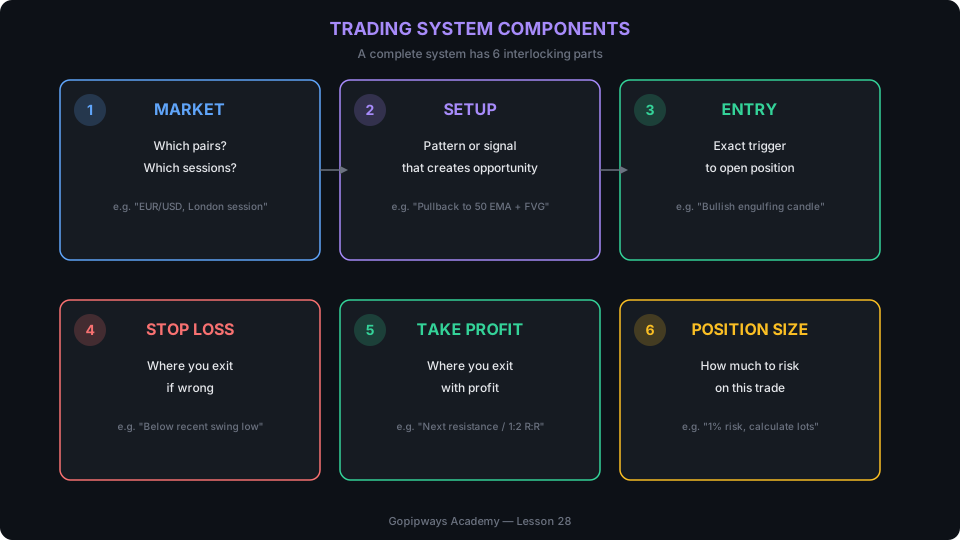
A trading system is not a collection of indicators. It is a complete decision-making framework that removes human emotion from every trading decision — before, during, and after the trade. The best trading systems are often the simplest. The worst are the most complex. Simplicity is reproducible under pressure; complexity breaks down the moment emotions arrive.
A trading system is a set of fully explicit, objective rules governing every aspect of your market participation: what you trade, when you trade, how you enter, how you size positions, how you manage open trades, and how you exit — both at targets and at stops.
The seven components of a complete system
1. Universe: "EUR/USD, GBP/USD on H1 during London and NY sessions."
2. Setup identification: "Price in uptrend (above 50 EMA, HH/HL structure). Pulls back to 61.8% Fibonacci. Bullish candle forms."
3. Entry trigger: "Buy on close of the confirming bullish candle."
4. Stop loss rule: "Below the most recent Higher Low, minimum 10 pips from entry."
5. Position size rule: "Risk 1% of current account balance. Calculate lot size from stop distance."
6. Trade management: "Move stop to breakeven when trade reaches 1:1 R:R. No further adjustment until target."
7. Exit rule: "Close at pre-defined target (1:2 R:R). No exceptions. No moving targets."
Why rules beat discretion
When you are watching a trade go against you at 3pm on a Friday, you cannot make good decisions under that emotional pressure. A documented system means the calm, rational version of you made the decision already. The emotional version of you simply executes. That is its entire psychological function.
Abbreviated system specification:
Name: FPS — Fibonacci Pullback System
Universe: EUR/USD, GBP/USD, H1 chart
Trend filter: Price above daily 200 EMA → buys only
Setup: Pullback to 50–61.8% Fibonacci after verified impulse with HH/HL structure
Entry: Close of bullish engulfing or pin bar within zone
Stop: 10 pips below pullback low · Position size: 1% account risk
Target: 2.0R · Breakeven: move stop to entry + 5 pips when trade reaches 1:1
Max open trades: 3 · Max portfolio heat: 5%
Trading hours: 9am–6pm WAT (London session and overlap only)
NGX system example: Universe: NGX top-20 stocks. Setup: weekly EMA bounce with RSI bullish divergence. Entry: Monday open after setup confirms on Friday close. Stop: 5% below entry. Target: previous resistance (typically 10–20% higher). Holds 2–6 weeks. Review every Sunday. This is a complete system — reproducible, objective, emotionless.
Confusing strategy with system. A strategy is an approach ("buy pullbacks"). A system specifies every decision rule without ambiguity. The test: could you hand this document to another person and would they make exactly the same trades as you? If not, it is not yet a system.
Write your system in a document and review it every Sunday. Ask: did I follow every rule this week? If not, write down which rules were broken and why. The answer will consistently be emotion, impatience, or FOMO. The written review creates accountability that verbal commitments never achieve.
A complete trading system eliminates discretionary decision-making from every trade by specifying rules for every possible scenario — making your trading reproducible, testable, and emotion-resistant.