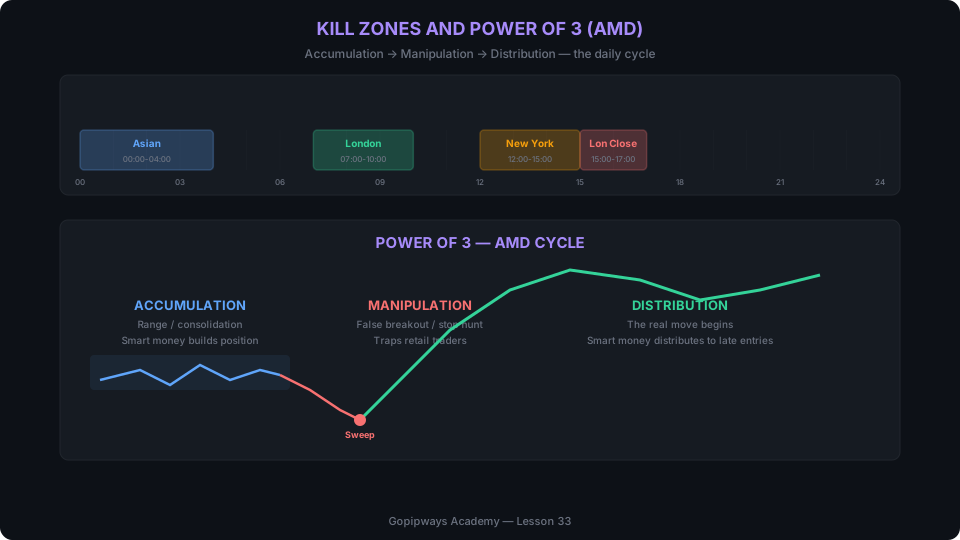
Michael Huddleston, known as ICT (Inner Circle Trader), observed something that changed how thousands of traders approach the market: institutional algorithms follow a repeating daily script. Every single trading day, price goes through three phases — accumulation, manipulation, and distribution. And these phases happen at specific times, not random ones. He called the high-probability time windows "kill zones" because that is where the real money is made — and where unprepared traders get killed.
Kill Zones are specific time windows during the trading day when institutional algorithms are most active — creating the highest-probability moves and the cleanest setups. Power of 3 (AMD) is the daily market cycle: Accumulation (range building), Manipulation (fake breakout/stop hunt), and Distribution (the real move in the intended direction).
The four kill zones (UTC)
1. Asian Kill Zone: 00:00 – 04:00 UTC
- The accumulation phase — price builds a range
- Identifies the day's high or low (Asian range high/low)
- Lowest volatility — institutions establish positions quietly
2. London Kill Zone: 07:00 – 10:00 UTC
- Often the manipulation phase — price sweeps the Asian range high or low
- Creates the day's opposite extreme (if the real move is bullish, London makes the low)
- Most impulsive moves begin here
3. New York Kill Zone: 12:00 – 15:00 UTC
- The distribution phase — the real directional move
- Often continues London's direction or reverses if London was the manipulation
- Highest volume and cleanest directional moves
4. London Close Kill Zone: 15:00 – 17:00 UTC
- Profit-taking and position squaring
- Often retraces 20-40% of the day's range
- Lower probability for new entries — used for exits and management
Power of 3 — AMD Cycle
A — Accumulation (Asian session):
Price consolidates in a tight range. Institutions quietly build positions. The Asian range high and low become the day's key levels.
M — Manipulation (London open):
Price breaks one side of the Asian range — triggering stops and luring retail traders in the wrong direction. This is the fake move designed to generate liquidity.
D — Distribution (New York session):
The real move. Price reverses the manipulation move and drives in the true institutional direction — distributing orders accumulated during the Asian session.
Trading the AMD cycle
1. Mark the Asian range high and low before London opens
2. Watch for London to sweep ONE side of the range (manipulation)
3. After the sweep, look for reversal confirmation (CHoCH on 15min)
4. Enter in the opposite direction of the sweep — this is the distribution
5. Target the opposite side of the Asian range and beyond
GBP/USD AMD cycle trade:
Asian range: 1.2720 (low) – 1.2745 (high)
London open: price drops to 1.2712, sweeping the Asian low (manipulation)
15min CHoCH forms at 1.2725 as price reclaims the range
Entry: 1.2728 (long after CHoCH) · Stop: 1.2708 (below sweep low)
Target 1: 1.2745 (Asian high) · Target 2: 1.2780 (higher liquidity)
Risk: 20 pips · Reward: 52 pips · R:R: 1:2.6
NGX parallel: NGX has its own "kill zone" pattern: the first 30 minutes after 10:00 AM open often shows manipulation — aggressive selling to shake weak hands. Stocks that drop 1-2% in the first 30 minutes then reclaim their opening price by 11:00 AM frequently rally for the rest of the session. This is AMD on a local equity exchange — accumulation (pre-market orders), manipulation (opening shake), distribution (the real move).
Trading during every kill zone. Each kill zone has a specific purpose — accumulation, manipulation, or distribution. Entering trades during the manipulation phase (thinking the breakout is real) is the most common mistake. Wait for the manipulation to complete, THEN enter during distribution.
Keep a "kill zone journal" for 2 weeks without trading. Mark the Asian range each day, note which side London sweeps, and record where NY distributes. After 10 trading days, you will see the AMD pattern repeat with shocking consistency — typically 6-7 out of 10 days follow the script. This builds conviction before you risk capital.
Kill zones are the high-probability time windows where institutional algorithms execute the daily AMD script — accumulation builds the range, manipulation fakes out retail traders, and distribution delivers the real move.