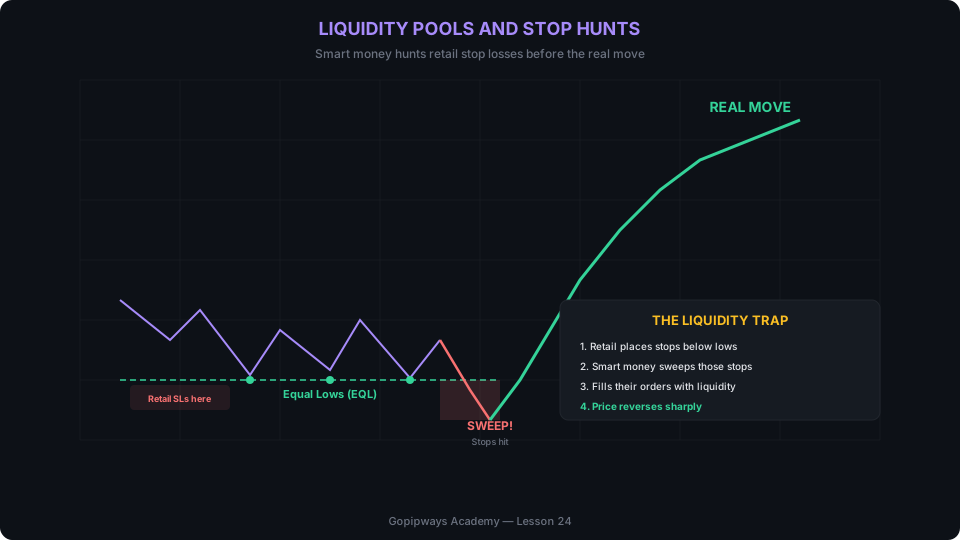
Every stop loss you have ever placed below a support level was part of a pool of liquidity that institutional traders were actively hunting. When that support "breaks" and your stop gets hit, triggering a sharp reversal immediately after — you did not just have bad luck. You were the liquidity. Understanding this is the single most transformative shift in perspective for an intermediate trader moving to advanced level.
Liquidity in Forex refers to pools of pending orders (stop losses and pending entries) clustered at predictable levels — equal highs, equal lows, swing points, and round numbers. Institutional traders and algorithms actively target these pools to fill their own large orders at optimal prices.
Where liquidity lives
Buy-side liquidity (orders above price):
- Equal highs / double tops — stop losses of short sellers + breakout buy orders
- Previous swing highs, round numbers
Sell-side liquidity (orders below price):
- Equal lows / double bottoms — stop losses of long traders
- Previous swing lows, round numbers
The liquidity sweep pattern
1. Price approaches a zone of sell-side liquidity (equal lows where stop losses cluster)
2. Price spikes briefly below the lows — sweeping the stops
3. Price immediately reverses with conviction back above the lows
4. The reversal continues to significant structural targets
This happens because institutions need the triggered stops to fill their large buy orders. They create the "breakdown" to generate the selling they need.
BOS and CHoCH
BOS (Break of Structure): In an uptrend, each new Higher High is a BOS — trend continuation confirmed.
CHoCH (Change of Character): When the trend's structure is violated for the first time. In an uptrend, CHoCH occurs when price breaks BELOW the most recent Higher Low — the first sign the trend may be reversing.
Liquidity sweep entry:
EUR/USD equal lows at 1.0850 (tested twice — retail stops clustered below).
Price dips to 1.0840 — stops triggered. Aggressive selling.
Within 3 candles, price reverses to 1.0875. Bullish engulfing on 15-min.
Entry: 1.0878 · Stop: 1.0832 (below sweep low) · Target: 1.0960 (next buy-side liquidity)
Risk: 46 pips · Reward: 82 pips · R:R: 1:1.8
NGX parallel: NESTLE NIGERIA repeatedly shows liquidity sweeps at support zones — the stock drops 2-3% below key support on thin volume (stop hunting), then reverses with a large volume surge. The reversal candle is the institutional buy. Recognising these sweeps on NGX charts transforms your interpretation of apparent "support breaks."
Treating every sweep as a guaranteed buy/sell signal. Not all sweeps reverse — sometimes the sweep IS the real breakout. Confirmation requirements: (1) the sweep candle must close BACK above the swept level, (2) a strong continuation candle must follow, (3) the sweep should occur at a confluence zone.
Before trading any support or resistance level, ask: "Is this level obvious to retail traders?" Obvious levels = high probability sweep target. This insight helps you: (1) avoid placing stops at obvious clusters — put them at structural levels slightly beyond sweep zones, and (2) wait for sweeps to complete before entering, not before they start.
Liquidity sweeps are engineered by institutional order flow to fill large positions at optimal prices — understanding this turns stop hunting from a frustrating mystery into a predictable, tradeable pattern.