When Goldman Sachs needs to buy $500 million of EUR/USD, they cannot place a market order — it would move the price dramatically against them. Instead, they place orders in batches, often hidden in specific candles and consolidation zones. Those zones are called order blocks. The retail trader who finds them is trading alongside institutional flow. The retail trader who ignores them is trading against it.
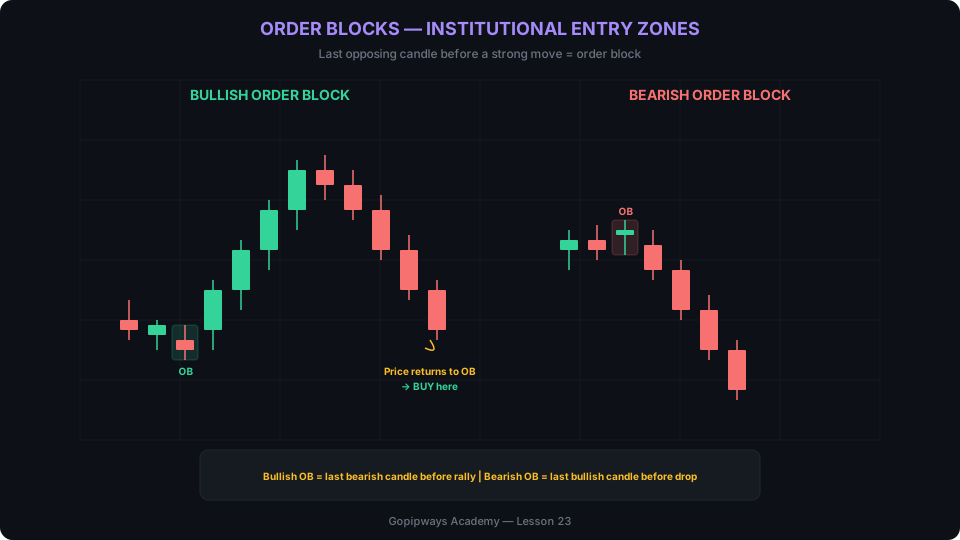
An order block is the last opposing candle before a significant directional move — typically the last bearish candle before a strong bullish impulse (bullish order block) or the last bullish candle before a strong bearish impulse (bearish order block). These zones represent where institutional traders placed large orders, creating a magnetic pull when price returns.
What makes a valid order block?
Bullish Order Block criteria:
1. A bearish (red) candle or cluster
2. Followed immediately by a strong bullish impulse breaking recent structure
3. The impulse leaves behind an imbalance (Fair Value Gap) — a gap where no trading occurred
4. The OB's body zone (open to close of the bearish candle) = your entry zone when price returns
Bearish Order Block: the reverse — last bullish candle before a strong bearish displacement.
Fair Value Gaps
A Fair Value Gap is a 3-candle pattern where the middle candle moves so fast that a gap exists between candle 1's high and candle 3's low. Price tends to return to fill these gaps — creating predictable future support/resistance zones.
Order block entry on EUR/USD daily chart:
Bearish candle: open 1.0950, close 1.0900 (the OB zone).
Followed by 4 strong bullish candles breaking above 1.1050.
Three days later, price returns to 1.0920 (within OB zone).
Entry: 1.0922 + bullish candle confirmation · Stop: 1.0880 (below OB)
Target: 1.1050 (top of original impulse)
Risk: 42 pips · Reward: 128 pips · R:R: 1:3.0
NGX parallel: Before major rallies in OANDO PLC, the chart consistently shows the same pattern: a bearish day or two of selling, then an explosive gap up on volume as institutional buyers accumulate. That "last red day before the gap" is the order block. When OANDO returns to that level on a low-volume pullback, it is an institutional re-accumulation entry — the same mechanics as Forex OBs applied to NGX equities.
Treating every bearish candle before an up-move as an order block. The displacement after the OB must be strong — breaking through significant structure, not just a minor pop. An OB without structural displacement is just a regular candle. Strength of the move away from the OB determines its validity.
Higher timeframe order blocks are stronger than lower timeframe ones. A daily OB holds much better than a 15-minute OB. When you find a daily OB that also coincides with a weekly level, you have a premium zone — where the largest institutional positions tend to concentrate.
Order blocks are the institutional footprint left in price — finding the last opposing candle before a strong impulse and waiting for price to return to that zone positions you alongside the same institutional traders who drove the original move.