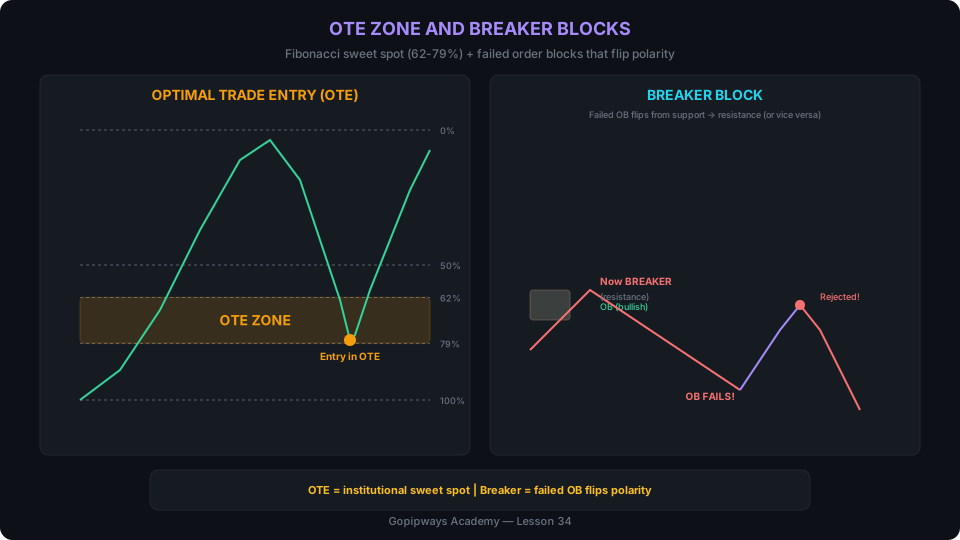
Most retail traders think a good entry means "buying at support." ICT traders think differently — a good entry means entering at the exact Fibonacci level within an order block where institutional orders concentrate most heavily. This level, between the 62% and 79% Fibonacci retracement, is called the Optimal Trade Entry. And when an order block fails and price breaks through it, it does not simply disappear — it transforms into something equally powerful: a breaker block. Understanding both gives you entries where institutions enter and re-entries where institutions reload.
Optimal Trade Entry (OTE) is the sweet spot between the 62% and 79% Fibonacci retracement of a significant price swing — the zone where institutional orders are most densely concentrated. Breaker Blocks are failed order blocks that have been violated — they flip from support to resistance (or vice versa), becoming new institutional reference levels.
The OTE zone
When price makes an impulsive move and then retraces, the deepest retracement where institutions reload is between 62% and 79%:
1. Draw Fibonacci retracement from the swing low to swing high (for bullish)
2. The zone between 62% and 79% = OTE zone
3. If an order block sits inside the OTE zone → maximum confluence entry
Why 62-79%?
- 50% is equilibrium — institutions start showing interest
- 62% is the golden ratio — high-probability reversal zone
- 79% is the deepest comfortable retracement before structure breaks
- Below 79% → risk of structural failure increases
Combining OTE with order blocks
The ultimate ICT entry:
1. Identify the impulsive move (displacement)
2. Draw Fibonacci from swing low to high
3. Look for an order block sitting between 62-79% retracement
4. Wait for price to retrace into that OB within the OTE zone
5. Enter with confirmation candle · Stop below the OB · Target the swing high and extensions
Breaker Blocks
When an order block FAILS — price breaks through it instead of bouncing — the OB transforms into a breaker block. It flips polarity:
Bullish OB that fails → Bearish breaker block:
- A bullish OB that should have held as support gets broken
- Price falls through it
- When price returns UP to that zone, it now acts as resistance
- This is where institutions who were wrong now have sell orders to mitigate losses
Bearish OB that fails → Bullish breaker block:
- A bearish OB that should have held as resistance gets broken
- Price pushes through it
- When price returns DOWN to that zone, it now acts as support
Why breaker blocks work
When an OB fails, traders who entered at that OB are now trapped in losing positions. When price returns to the level, they exit (closing longs = selling; closing shorts = buying). This exit activity creates a reliable reaction at the breaker level.
Breaker block entry rules
1. Identify a clear OB that was violated (price closed beyond it)
2. Wait for price to return to that zone from the other side
3. The old support OB is now resistance (and vice versa)
4. Enter with confirmation on the retest · Stop beyond the breaker · Target the next structural level
EUR/USD OTE entry:
Swing low: 1.0800 · Swing high: 1.0900
OTE zone: 62% = 1.0838, 79% = 1.0821
Bullish OB at 1.0825-1.0835 (sits perfectly in OTE zone)
Price retraces to 1.0830 (inside OB + inside OTE) · Bullish pin bar forms
Entry: 1.0835 · Stop: 1.0815 (below OB/OTE) · Target: 1.0900+
Risk: 20 pips · Reward: 65+ pips · R:R: 1:3.25
Breaker block example:
That same OB at 1.0825 gets broken — price closes at 1.0810.
Later, price rallies back to 1.0830 (retesting the broken OB).
Now it is a bearish breaker → Entry: short at 1.0828
Stop: 1.0848 · Target: 1.0770 · R:R: 1:2.9
NGX parallel: SEPLAT ENERGY had a bullish OB around ₦2,800 that held twice. On the third test, price broke below to ₦2,720. Two weeks later, SEPLAT rallied back to ₦2,800 — but now it was a breaker block (resistance). Price rejected at ₦2,810 and dropped to ₦2,650. Traders who bought at ₦2,800 expecting "support" were caught by the breaker flip.
Using the OTE zone without an order block inside it. The OTE zone is a filter — it tells you WHERE to look for entries, but the OB provides the actual entry trigger. OTE without an OB is a zone with no specific level. OB without OTE might be at a poor retracement depth. Together, they define the institutional sweet spot.
When you see an order block get violated, do not delete it from your chart. Immediately re-label it as a breaker block and flip your bias. The best breaker trades happen quickly — within 1-3 days of the break. After that, the trapped traders have mostly exited and the level loses potency. Fresh breakers are the strongest.
The OTE zone (62-79% Fibonacci retracement) pinpoints where institutional orders concentrate most — combine it with an order block for the highest-precision entry, and when an OB fails, flip it into a breaker block that provides equally powerful entries in the opposite direction.