Nick Leeson brought down Barings Bank — founded in 1762, one of Britain's oldest institutions — by repeatedly adding to losing positions with no stop loss, trying to recover losses. He did not lack skill or intelligence. He lacked the 1% rule. It sounds boring. It is the most important rule in trading.
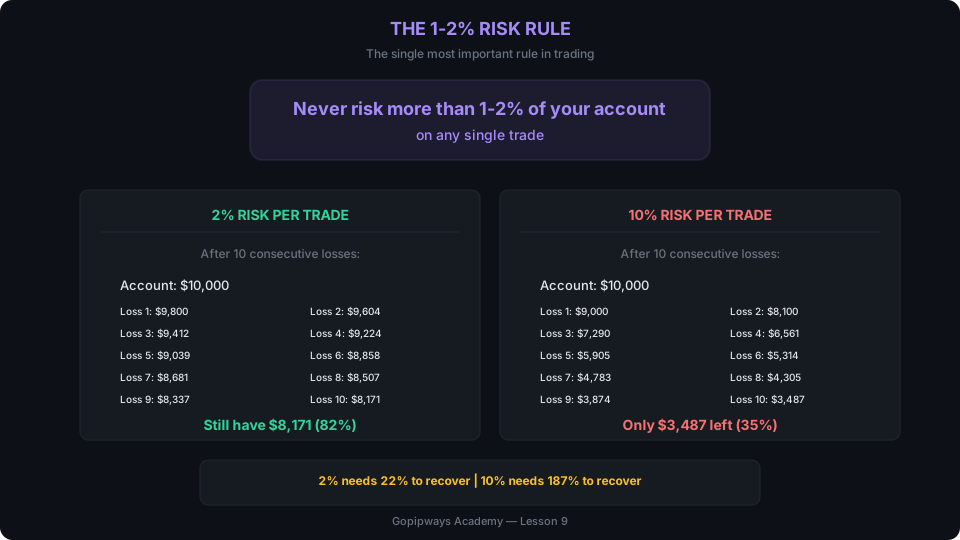
The 1-2% rule states that no single trade should risk more than 1–2% of your total account balance. This rule means you can be wrong 50 times in a row and still have over 60% of your account intact — enough to continue trading and recover.
The maths of survival
| Risk per trade | After 10 losses | Remaining |
|---|---|---|
| 1% | (0.99)^10 | 90.4% |
| 2% | (0.98)^10 | 81.7% |
| 5% | (0.95)^10 | 59.9% |
| 10% | (0.90)^10 | 34.9% |
| 20% | (0.80)^10 | 10.7% |
A 20% risk per trade does not require bad luck to destroy an account — it requires a completely ordinary losing run.
Why 1% feels small (and why that feeling is wrong)
At 1% risk on a $5,000 account you risk $50 per trade. A 1:2 R:R wins $100. Five consecutive winners grows the account meaningfully. You can take 50 trades exploring a strategy without blowing up. Your psychology stays stable because no single loss hurts.
At 10% risk, three losses cost you 27% of your account. Psychology breaks down, revenge trades follow, the spiral begins.
Two traders, $10,000 each, same 5-loss/5-win sequence (1:2 R:R):
Trader A (1% risk): 5 losses = −$500. 5 wins on growing balance ≈ +$1,050. Net: +$550 profit.
Trader B (10% risk): 5 losses = account down to $5,905. The emotional damage after losing $4,095 leads to revenge trades before the wins arrive. Account further damaged.
Same sequence. Radically different outcomes because of risk size.
NGX parallel: A disciplined NGX investor with ₦1,000,000 risks no more than ₦10,000–₦20,000 per stock position. When OKOMU OIL gaps down on bad earnings, the loss is manageable — not account-ending. This discipline allows surviving the inevitable bad runs that hit every investor.
"I will use 5% just until I build the account up, then lower it." This is the most common and most fatal beginner plan. The high-risk phase comes when you have the least experience and the least proven strategy — exactly when you need the lowest risk, not the highest.
During a drawdown (3+ consecutive losses), reduce risk to 0.5% until you have 3 winning trades at the lower size. This circuit breaker prevents the psychological spiral that turns a normal losing streak into an account-destroying event.
Risk 1–2% per trade, always — because surviving long enough to become profitable requires protecting the account through every losing streak your strategy will inevitably produce.