Jesse Livermore, the most famous speculator in Wall Street history, had one rule that explained his entire fortune: "Never fight the tape." The tape was the ticker — the direction the market was already moving. He did not care about predicting where price would go. He cared about knowing what direction price was already travelling and riding it. That was his entire edge.
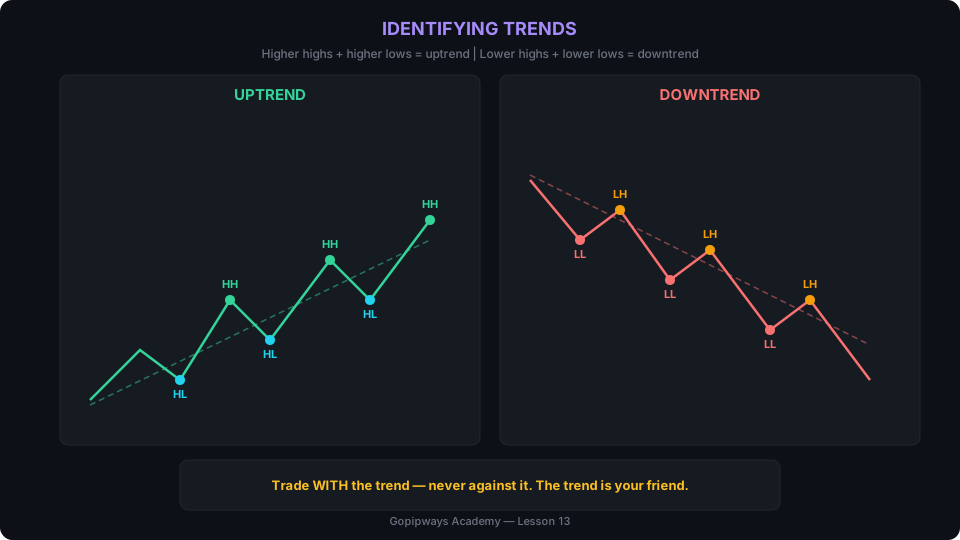
A trend is a sustained directional bias in price — a series of higher highs and higher lows (uptrend) or lower highs and lower lows (downtrend). Trending markets provide the most reliable and highest-probability trading setups available.
The structure of a trend
Uptrend — the staircase up:
Price makes a new high (Higher High = HH), pulls back to a higher point than the previous pullback (Higher Low = HL), then makes a new HH again. The HL series is your confirmation that buyers are in control — each pullback finds support at a higher level.
Downtrend — the staircase down:
Price makes a new low (Lower Low = LL), bounces to a lower level than the previous bounce (Lower High = LH), then breaks to a new LL. LH series confirms sellers are in control.
Sideways / Ranging:
Price oscillates between clear support and resistance without consistent new highs or lows. Different trading rules apply.
Trend entry logic
The lowest-risk entry in a trend is not at the high or low — it is on the pullback.
- Uptrend: wait for price to pull back toward a Higher Low, show bullish reversal signals, then buy.
- Downtrend: wait for price to bounce toward a Lower High, show bearish reversal signals, then sell.
Uptrend pullback entry:
EUR/USD uptrend: HH1 at 1.0950, HL1 at 1.0880, HH2 at 1.1020.
Price pulls back toward expected HL2 (~1.0930–1.0950).
Bullish engulfing forms at 1.0940.
Entry: 1.0942 · Stop: 1.0905 (below HL zone) · Target: 1.1020 (previous HH)
Risk: 37 pips · Reward: 78 pips · R:R: 1:2.1
NGX parallel: ZENITH BANK spent Q1 2024 in a clear uptrend — each pullback found buyers at higher levels. Traders who waited for pullbacks to the higher-low zones (not chasing new highs) consistently entered with 1:2+ R:R setups. The same structure repeats across every NGX blue chip in trending conditions.
Trying to find a trend on a single timeframe. A 5-minute chart can look like a strong uptrend while the 4-hour is clearly in a downtrend. Higher timeframe trend direction must be established first — it sets the bias. If the daily trend is down, look for sells on lower timeframes, not buys.
A simple rule to define trend: two Higher Lows in a row = uptrend confirmed. Two Lower Highs in a row = downtrend confirmed. No indicators needed. Just mark HH/HL or LH/LL on your chart and let structure speak for itself.
Trading with the trend means waiting for pullbacks to higher lows (uptrend) or lower highs (downtrend) — entering where the trend's next push is most likely to begin with the best risk-reward available.